Falls are one of the main health risks for older adults in India. About 1 in 8 people over 60 reported a fall in a two-year period, and falls caused most of the fractures older adults reported in the same national survey (1, 2).
The short answer: Assisted living can lower the risk of falls, but only when a community has a working system for it. That system checks each resident’s risk, keeps residents strong and active, makes the bathroom and the night safe, and changes something after every fall. Safety rails and a well-kept building do not show whether that system exists, so ask.
This guide explains why falls happen, what a good fall prevention program looks like day to day, and how to check it when you visit a community.
How common are falls in India, and what do they lead to?
A fall is rarely a one-off event. It can lead to a fracture, surgery, a hospital bill, and a loss of independence, and it makes the next fall more likely.
The national ageing survey, LASI, found that 12.63% of adults over 60 had fallen in the previous two years. That is about 1 in 8.
Falls also cause serious injury. Among LASI respondents aged 45 and over, 4.2% reported a fracture. Falls caused 87% of those fractures, 43% needed surgery, and out-of-pocket spending was more than twice as high in private hospitals as in public ones. In plain terms, when an older adult in India breaks a bone, a fall is usually the cause, and it is often a major event.
The first fall also matters because of what comes next. The US CDC reports that falling once doubles the chance of falling again (3). Many people who fall become afraid of falling and move less, which makes them weaker and more likely to fall. Prevention works best when it starts before the second fall.
Which older adults are most likely to fall?
Falls are not random. LASI data shows which health problems raise the risk. Where you see “odds”, read it as “more likely to fall”.
- Frailty: About 30% of Indians over 60 are frail, meaning weak and slow. 15.4% of frail adults had fallen, compared with 11.9% of others (4).
- Several long-term conditions: These often come with several medicines, and the CDC notes that some medicines, including a few sold over the counter, can affect balance.
- Poor sleep: The odds of falling were 43% higher.
- Pain: The odds of falling were 80% higher.
- Low vision: In a study of 41 homes for the aged in Hyderabad, about 3 in 10 residents had visual impairment. They were more likely to fall, especially when glasses could have corrected their vision (5).
These are often the same needs that lead a family to consider assisted living. The good news is that sleep, pain, vision, medicines and muscle strength can all be addressed, and the CDC lists many of them as risk factors that can be changed. If your parent has already fallen more than once, our guide on when an elderly parent keeps falling explains when to consider assisted living.
Do falls still happen in assisted living?
Yes. Falls can happen in any care setting, which is why a community’s approach to prevention matters more than its building. We did not find public fall figures for individual assisted living communities in India. The closest evidence is the Hyderabad study of 1,074 residents in 41 homes for the aged, which found that 29.1% of residents fell in one year. That is nearly 3 in 10.
This was a different type of study from LASI, so the figures are not a direct comparison. It shows that residents are often people with a high risk of falling to begin with, and that fall prevention has to be part of their daily care.
A 2026 study of 1,700 care homes in England adds detail on how falls repeat (6). Among residents who fell, 45% fell three or more times, and most falls happened in the bedroom, the lounge and the bathroom. Residents who fell were also more likely to be admitted to hospital, at 54% compared with 34%.
What does a good fall prevention program look like?
A good program has four parts. They work as a loop: every fall should lead back to a fresh assessment.
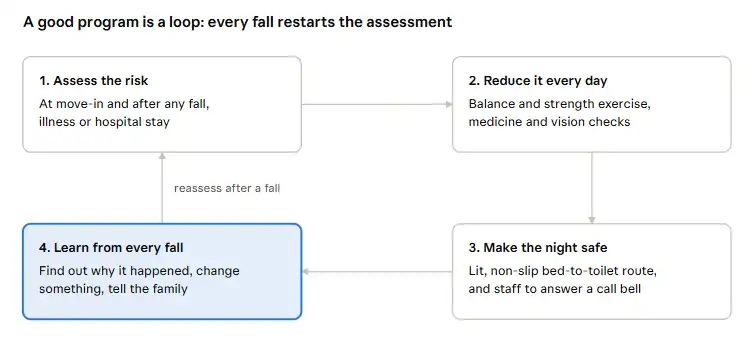
Each part is explained below, with the question to ask and what a good answer sounds like.
1. Assess the risk
When a resident moves in, a nurse or physiotherapist checks balance, strength, vision and medicines. The check repeats after a hospital stay, an illness or a fall, because risk changes.
This matters because most falls have several causes. The CDC notes that the more risk factors a person has, the higher the chance of a fall.
Ask: How do you assess a new resident’s fall risk, and who does it?
A good answer names who does the check, what it covers, and when it repeats.
2. Reduce the risk every day
Three things happen routinely in a good community. Balance and strength exercise runs regularly, led by a physiotherapist or trained instructor. A doctor reviews each resident’s medicines, and again after a fall. Residents get eye checks and up-to-date glasses.
Exercise has the strongest evidence. A Cochrane review of 108 trials found that exercise of all types reduced falls by 23%. Balance and functional exercises reduced falls by 24%, and adding strength training reduced them by 34% (7). That is about one fewer fall in every four, or one in three with strength work added. These trials involved older adults living at home, so results in a care setting may differ.
Medicines and vision matter too. Some medicines affect balance, and in the Hyderabad study, residents with vision problems that glasses could fix were the ones falling more.
Ask: How often do exercise sessions run, and who leads them?
A good answer gives a fixed schedule and a named physiotherapist or instructor. “Residents are encouraged to stay active” is not an answer.
3. Make the night safe
Most falls in care homes happen in the bedroom, the lounge and the bathroom. That makes the walk from the bed to the toilet the most important route to check. A good community has:
- Night lights along the route from bed to toilet.
- Grab bars in the bathroom.
- A non-slip floor and a shower without a step. Many Indian bathrooms are a single wet area, so a good one keeps a dry area separate.
- A call bell within reach, and enough staff on duty at night to answer it quickly.
- Footwear that fits and grips. The CDC lists poor footwear as a risk factor, and loose chappals are an easy example.
Ask: How many staff are on duty at night, and for how many residents?
A good answer gives a number, and says how quickly the call bell is answered.
4. Learn from every fall
In the England study, 45% of residents who fell went on to fall three or more times. Together with the CDC finding that one fall doubles the chance of another, this means what happens after the first fall matters most. In a good program:
- Staff record every fall and work out why it happened.
- They change something as a result, such as the room layout, the medicines or the help given at night.
- The family is told promptly, ideally the same day.
Ask: What happens in the 24 hours after a fall, and when is the family told?
A good answer describes specific steps and a time frame, not “we will let you know”.
Why do you need to ask, not just look?
In the England study, a care home’s fall rate and hospital admission rate had no significant link to its official quality rating from the Care Quality Commission, the care regulator for England. A good rating or a well-kept building did not predict how many falls happened. We did not find a comparable public record for individual communities in India, so a visit and the right questions are the best check available.
The most useful single question is:
“Can you tell me about the last fall here, and what you changed afterwards?”
| Approach | What you hear |
|---|---|
| A working program | A specific story: what happened, why, what changed, and when the family was told. |
| An informal process | A general reply, such as “our staff are very careful.” |
For example, a specific answer sounds like this: “Last month a resident slipped near the bathroom door. The floor stayed wet after showers, so we added a non-slip mat and a night light, and we called the family that evening.”
How to check fall prevention when you visit
Use this checklist on a visit:
- Ask how fall risk is assessed at move-in, and when it is reassessed.
- Ask how often exercise sessions run, and who leads them.
- Ask who reviews each resident’s medicines, and how often.
- Ask how many staff are on duty at night, and for how many residents.
- Walk the route from a resident’s bed to the toilet with the main lights off.
- Check the bathroom for grab bars, a non-slip floor, and a shower without a step.
- Ask what happens in the 24 hours after a fall, when the family is told, and what changed after the last fall.
Which assisted living operators state their fall prevention approach?
Some operators state their fall prevention measures on their own websites. Three examples, based on what each says publicly:
- Antara Senior Living: A 2025 post on its care home lists anti-slip floors, handrails, grab bars in all washrooms, and nurse call buttons in every room and washroom. It also describes a physical therapy program for mobility, pain management and fall prevention, and equipment meant to improve stability and reduce fall risk (8).
- Athulya Senior Care: Its safety page lists grab rails along corridors, bathroom grab bars, toilet support rails, anti-slip flooring, safety rails on staircases, carpets stuck to the floor, and chairs with armrests. It also describes an alert system in each room that signals when a resident falls or has an emergency (9).
- Primus senior living: Its senior living communities describe homes with anti-skid flooring, grab bars and emergency buttons (10). Primus describes its Bangalore community as suited to largely independent seniors, so it is closer to independent living with support than to assisted living.
These features matter. Grab bars, non-slip floors and night lighting remove hazards, and call bells and fall alerts speed up help. What a website rarely shows is the system behind them: how risk is assessed, how often exercise runs, how many staff are on duty at night, and what changes after a fall. Use the questions in this guide to check that part on a visit.
Frequently asked questions
Can assisted living prevent falls completely?
No. Programs reduce falls, they do not remove them. Exercise cut falls by about a quarter in the Cochrane review, and nearly 3 in 10 residents in the Hyderabad study still fell in a year. The aim is fewer falls and a better response when one happens.
Are falls more common in assisted living than at home?
Residents are usually older and frailer than people their age who live independently, so their risk is higher before they move in. The Hyderabad study found that 29.1% of residents fell in a year, compared with 12.63% over two years in the national survey. The studies differ, so the figures are not directly comparable. The useful question is how a community lowers the risk it starts with.
What should I ask an assisted living community about fall prevention?
Ask how risk is assessed, how often exercise runs and who leads it, how many staff are on duty at night, and what happened after the last fall. The checklist above has the full list.
Should one fall mean a move to assisted living?
A fall is a reason to review risk, not a decision by itself. Falling once doubles the chance of falling again, so check vision, medicines, footwear and the home first. Our guides on when an elderly parent keeps falling and when it is no longer safe for an elderly parent to live alone cover how to decide.
What can families do at home to reduce falls?
The CDC lists risk factors that can be changed: weak legs, balance problems, some medicines, vision problems, poor footwear and home hazards. Families can act on these with regular exercise, a medicine review, an eye test, better footwear, better lighting, and by removing things that cause tripping.
Conclusion
Fall prevention for seniors comes down to a system, not a set of features. A good community assesses risk, reduces it every day, makes the night safe, and learns from every fall.
You can check each part on a visit. Ask about the last fall, walk the route from bed to toilet, and ask how many staff are on duty at night.
If your parent still lives alone, read when it is no longer safe for an elderly parent to live alone in India. Compare assisted living communities at Zenioro.
Sources
(1) LASI, Scientific Reports, 2023: sleep problems, pain and falls among older adults in India
(3) US Centers for Disease Control and Prevention: facts about older adult falls
(4) LASI, PLOS ONE, 2022: physical frailty and falls among older Indian adults
(6) Health Science Reports, 2026: falls among residents of 1,700 care homes in England
(7) Cochrane review, 2019: exercise for preventing falls in older people living in the community
(8) Antara Senior Care: the new era of assisted living in Antara Care Homes