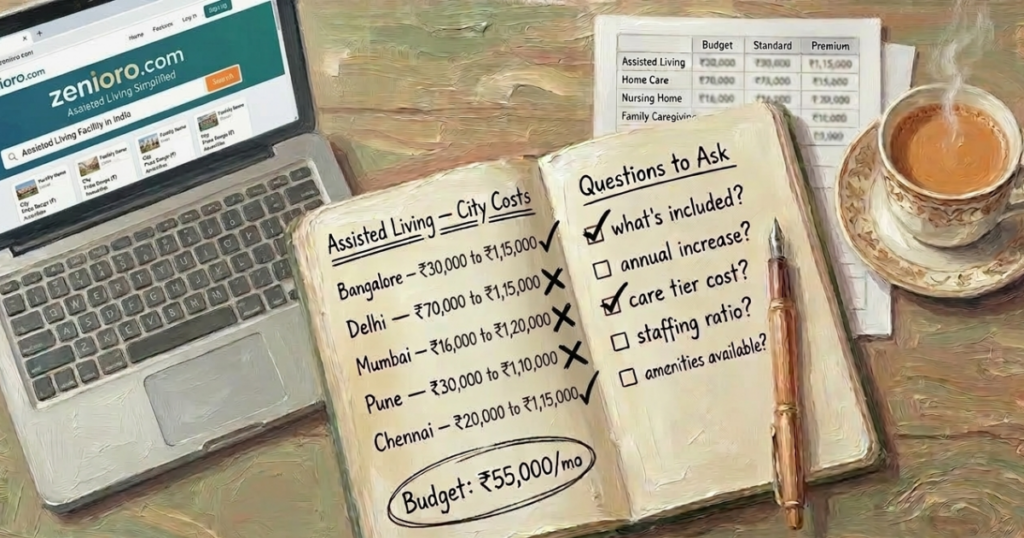
Everything you need to know: why drives the cost, city-by-city breakdowns, what’s included, and how to plan.
What Does Assisted Living Actually Cost in India?
Assisted living in India starts from ₹20,000 and can go upto ₹1,20,000 and above per month for premium facilities depending on the city, the facility, room type and the level of care your parent needs. Most standard assisted living facilities are moderately priced, typically ranging between ₹50,000 – ₹70,000/month in metro cities. These facilities generally offer private/shared rooms, 3 meals a day, 24/7 care with 1:3 staff-to-resident ratio, housekeeping and laundry, emergency response systems, and structured recreational and social activities.
Two residents may move into the same assisted living facility in the same city. Choose the same room type. Eat in the same dining hall. Attend the same activities. And yet at the end of the month, receive different bills. Where does this difference come from?
In non-metro cities, shared rooms typically start from ₹20,000/month and private rooms from ₹40,000/month. In metro cities, shared rooms start from ₹50,000/month and private rooms from ₹65,000/month, going up to ₹1.5 lakh and above for premium facilities.
Shared occupancy can reduce costs by 15–30%, but in most cases, care requirements influence the final bill more than room type does.
Assisted living pricing in India is layered. The final number you see every month is built from multiple components; some fixed, some variable, and some dependent on health.
Assisted living pricing typically has four layers:
•Base Stay Cost (60–75%)
•Care Level Charges (10–30%)
•Add-Ons (0–40% depending on usage)
•One-Time Charges (Admission fee, security deposit)
What’s included in the monthly fee and what isn’t
The monthly fee covers the essentials every resident uses: accommodation, meals, housekeeping, and basic caregiving. What may be charged extra is personal: physiotherapy, personal caregiver, specific dietary need.
Understanding this distinction helps you compare two facilities honestly, plan a realistic budget, and ensure your parent’s specific needs are actually being met
Typically Included:
- Accommodation: shared or private room
- 3-4 meals per day plus snacks
- Housekeeping and laundry
- Basic health monitoring: daily vitals, medication reminders, basic first-aid
- Activities and social programmes: yoga, music, cultural events, group outings
- 24/7 staff support: caregivers and supervisory staff round the clock
- Emergency call systems and basic safety infrastructure
- Common area access: gardens, lounges, activity rooms, TV rooms
Typically Extra:
- Specialist doctor visits and consultations
- Physiotherapy sessions
- Incontinence supplies(adult diapers, pads, and consumables)
- Transportation: Personal or emergency
- Private nursing/caregiver
- Air conditioned rooms
- Special dietary requirements: diabetic meals, low-sodium, jain, or texture-modified
- Personal grooming services: haircuts, spa or treatments
- Guest meals and overnight guest accommodation
- Concierge services
City-by-city cost breakdown
India’s assisted living market does not have uniform pricing. Factors like local real estate costs, labour markets, demand density, and compliance cost all affect what you pay. The table below gives you a reference average range in 3 slabs for 9 major cities.
| City | Budget | Standard | Premium |
| Bangalore | ₹22,000 – ₹35,000 | ₹50,000 – ₹60,000 | ₹1,00,000 – ₹1,20,000+ |
| Delhi-NCR | ₹22,000 – ₹55,000 | ₹70,000 – ₹80,000 | ₹90,000 – ₹1,20,000+ |
| Mumbai | ₹16,000 – ₹50,000 | ₹55,000 – ₹80,000 | ₹1,00,000 – ₹1,20,000+ |
| Chennai | ₹20,000 – ₹35,000 | ₹50,000 – ₹60,000 | ₹1,00,000 – ₹1,20,000+ |
| Hyderabad | ₹25,000 – ₹35,000 | ₹50,000 – ₹60,000 | ₹80,000 – ₹1,20,000+ |
| Kolkata | ₹22,000 – ₹40,000 | ₹40,000 – ₹60,000 | ₹60,000 – ₹1,20,000+ |
| Pune | ₹30,000 – ₹45,000 | ₹47,000 – ₹70,000 | ₹75,000 – ₹1,20,000+ |
| Kochi | ₹25,000 – ₹35,000 | ₹50,000 – ₹70,000 | ₹70,000 – ₹1,20,000+ |
| Coimbatore | ₹30,000 – ₹45,000 | ₹50,000 – ₹60,000 | ₹60,000 – ₹1,20,000+ |
Note: These figures are per month for a single occupant.. Final monthly costs vary based on room type, care plan, and add-on services. Budget typically means a shared room with basic care and meals. Standard means a private or semi-private room with standard care services. Premium means a private suite with enhanced care services. Figures are indicative of 2024–2025 market rates.
City Notes
Delhi-NCR
Delhi-NCR has the widest price variation of any metro because “NCR” spans multiple cities with very different cost bases. Gurgaon and Noida host the most professionally run private facilities ranging ₹90,000–₹1,50,000+ for quality assisted living. South Delhi and Greater Noida offer more affordable options. Air quality is a genuine consideration for seniors with respiratory conditions when evaluating options here.
Check out the best assisted living facility in Delhi-NCR.
Bangalore
Bangalore’s assisted living market has grown significantly over the past five years, driven partly by the city’s large NRI-origin population and tech-sector returnees seeking quality care for parents. The Whitefield, Sarjapur Road, and Electronic City corridors have seen several well-run facilities open at mid-market price points. Climate is the best of any metro for seniors.
Check out the best assisted living facility in Bangalore.
Mumbai
Mumbai is the most expensive assisted living market in India, principally because of real estate. Facilities in Bandra, Juhu, and South Mumbai command ₹1,20,000 and above per month. However, the Navi Mumbai and Thane belt offers comparable quality at 25–35% lower cost.
Pune
Pune has emerged as one of the strongest value markets in Maharashtra. The combination of relatively lower real estate costs, pleasant climate, quality hospitals, and proximity to Mumbai makes it an increasingly popular choice for families who want proximity to a metro without metro pricing.
Chennai
Chennai is the most affordable major metro for assisted living with many facilities located beachside. Quality standard options are available from ₹50,000–₹60,000/month. The city’s strong hospital infrastructure is a significant advantage for families with medically complex parents.
Check out the best assisted living facility in Chennai.
Hyderabad
Hyderabad offers one of the strongest value propositions in assisted living comparable to larger metros at 20–30% lower cost. Facilities in the Jubilee Hills and Gachibowli corridors sit within minutes of some of the best hospital infrastructure.
Kochi
Kochi offers the best value for money in assisted living outside the four main metros, backed by one of the highest trained-nurse ratios in the country. For Gulf NRI families, it’s the natural choice, a direct flight away and familiarity in language and food for most. The landscape and climate make it easier for seniors to settle and feel at home.
Coimbatore
Coimbatore is the city families choose when they decide care quality matters more than city proximity. Clean air, lower pollution, and a pace of life genuinely suited to ageing that no metro can match. The medical ecosystem adds a strong backstop for complex care needs. And the pricing starting at ₹30,000 and for premium rarely exceeding ₹80,000 makes it the most compelling value market in India.”
Kolkata
Kolkata’s assisted living market is growing. Built around cultural continuity, food and festivals this market provides texture of daily life. Pricing is among the lowest of any major city.
What drives the cost of assisted living
Understanding why prices vary helps you evaluate whether a quote is reasonable and how to reduce costs without compromising on care quality.
1. Level of Care
Care level is the single biggest cost driver in assisted living. Before admission, facilities conduct an overall assessment covering health history, mobility, cognitive function, and any existing conditions. This is used to determine which tier of care your parent actually needs. Next section dives into cost breakdown for each care level.
2. Room Type
The room your parent lives in is the second biggest factor in what you pay. Largely, facilities offer these 3 options.
- Shared room(₹20,000–₹40,000/month): Two to three residents per room, shared bathroom. The most affordable entry point into assisted living.
- Single room(₹40,000–₹1,20,000/month): Private room with an attached bathroom. The standard choice for most residents, balancing comfort, privacy and cost.
- Suite(₹1,20,000–₹1,75,000/month): A larger private space, often with a sitting area, kitchenette, and enhanced furnishings. Common in premium facilities catering to higher comfort expectations
3. City and Neighbourhood
Cities like Mumbai, Bangalore, and Delhi offer better healthcare networks, stronger connectivity, and more established infrastructure. A facility in Gurgaon or Whitefield is paying for access to all of that, and hence pricing itself higher.
Even within the same city, a facility that is well-connected, accessible by major transport routes, and close to hospitals will be priced higher than one on the outskirts.
Premium neighbourhoods within any city: Bandra in Mumbai, Koramangala in Bangalore, Defence Colony in Delhi command 30–50% higher rates than comparable facilities.
4. Facility Type
Running a facility legally requires fire safety certifications, food licensing, nursing staff credentials, and periodic inspections. This is a fixed cost.
A 20-bed facility and a 100-bed facility pay roughly the same amount to stay compliant, but the larger one splits that cost across five times more residents. The smaller facility recovers the same expense from fewer people which is one reason boutique facilities are often priced higher than larger ones, even when care quality is comparable.
- Boutique residential homes (10–30 residents, converted bungalows or villas)
- Large purpose-built communities (100+ residents)
5. Meals and Dietary Requirements
Standard vegetarian Indian meals are included in most base fees. Diabetic meals, low-sodium diets, texture-modified diets (for swallowing difficulties), and specific regional cuisines are typically charged extra.
It is advised to confirm exactly what the kitchen can provide, to cover your parent’s specific dietary need.
6. Add-On Services
Add-ons make pricing dynamic. These are services beyond the standard care tier.
Add-ons can increase the monthly bill by 15–40%, depending on frequency and intensity. This is how a ₹60,000 base becomes ₹85,000.
Physiotherapy, specialist consultations, dental care, occupational therapy, and dedicated one-on-one caregiver time are priced separately.
Now that you know what factors impact the cost, use our assisted living cost calculator to get an estimate for your specific situation
Cost by Care Type
Based on the assessment conducted at admission, your parent will be placed in one of the care tiers below. Senior care is progressive, not a one-time decision.
Your parent may begin in independent living, move to assisted living as mobility declines, and later require memory or palliative care as clinical needs evolve.
Understanding what each tier costs today helps you plan for what it may cost tomorrow.
| Care type | Average range | Who is it for |
| Independent living | ₹25,000 – ₹75,000/ per month | Seniors who are largely self-sufficient but want community, safety, and a maintenance-free lifestyle. |
| Assisted living | ₹30,000 – ₹1,20,000/ per month | Seniors who need daily support with personal care, medication, or mobility but do not require constant medical supervision |
| Memory care | ₹60,000 – ₹1,80,000/ per month | Seniors living with dementia or cognitive decline who need a secure environment and specialist-trained staff |
| Respite care | ₹2000 – ₹7000/per day | Seniors whose family caregivers need a short break, stays typically range from one to four weeks |
Why Memory Care Costs More
Memory care and dementia care facilities require a significantly higher staff-to-resident ratio, specially trained staff (dementia care is a distinct skill set), secure environments to prevent wandering, structured cognitive activity programmes, and more intensive medical oversight. These are not amenities but safety requirements.
Expect to pay 20–40% more than a standard assisted living rate, and verify that the facility’s staff have actual dementia care training rather than general caregiving experience.
Respite Care: Flexibility Has a Cost
Respite stays (typically 1–4 weeks) are priced at a daily rate that is usually 15–25% higher than the equivalent monthly rate. This is because facilities cannot fill that bed easily if a resident leaves early.
However, respite care is often significantly cheaper than the hidden costs of a family caregiver burning out.
How Pricing Is Structured
Understanding the billing structure of a facility is as important as understanding the monthly amount. Many families discover the model only after they have committed.
| Model | How It Works |
| All-Inclusive | One flat monthly fee. No billing surprises. Best for families who want predictability. |
| Base Fee + Care Tier | Accommodation is fixed; care level (basic / assisted / intensive) adds a surcharge. Common in mid-range facilities. |
| À La Carte | Pay only for services used. Can be economical for independent seniors; costs rise sharply if needs increase. |
| Entry Deposit Model | ₹5 – ₹20 lacs upfront refundable deposit, then lower monthly fee. Common at premium branded communities. |
Annual Escalation Clauses: Read This Before You Sign
Most facilities include an annual fee escalation clause, typically 8–15% per year. This is standard and not inherently unreasonable given India’s healthcare and labour inflation.
Some contracts allow unlimited increases or tie increases to poorly defined “market rates.”
Always ask: Is the annual increase capped? Is it linked to a specific index? What is the notice period before a rate increase takes effect? Get the answers in writing.
Care Tier Upgrades
Many families under-budget because they plan for current needs, not future needs. A parent admitted at the independent living tier may transition to assisted living as health changes.
Ask the facility what triggers a care tier upgrade and what the financial impact is.
A facility that is honest about this is one you can trust.
Cost Comparison: Assisted Living vs the Alternatives
For many, the first instinct when a parent needs help is to arrange a caregiver at home. Moving to assisted living is often seen as same service outside the house.
When you account for caregiver salaries, supervision gaps, home modifications, and the invisible toll on family members who step in, assisted living often becomes not just the more practical choice, but the more economical one too. Here’s how assisted living compares across alternatives.
| Care setting | Average monthly pricing | What’s included |
| Assisted Living Facility | ₹20,000 – ₹1,20,000 | Care + accommodation + meals + activities + safety and security |
| Home Care (Full Time) | ₹25,000 – ₹60,000 | Basic medical and personal care + companionship + household help |
| Nursing Home | ₹20,000 – ₹80,000 | Medical care + accommodation + meals + rehabilitation + clinical supervision |
| Family Caregiving | Free | Care + meals + companionship |
The Real Cost of Family Caregiving
Family caregiving is almost never free. The costs are just distributed and hidden:
- a sibling who reduces work hours or quits a job
- the psychological toll of caregiver burnout (estimated to affect 40–60% of primary family caregivers within two years)
- medical consequences of care gaps
- relationship strain.
These costs are real even when they do not appear in a bank statement.
Home Care vs Assisted Living
There is no direct one-to-one comparison between home care and assisted living, as its not about which is better. The focus is on which option fits the senior’s needs, routine, and living situation.
The distinction becomes clearer when viewed through daily life: how care is delivered, how support is available throughout the day, and how each model affects safety, supervision, and routine.
We explore this in detail in our guide to assisted living vs home care.
Questions to Ask Before Signing
Print this list. Take it to every facility visit. The quality of the answers tells you as much as the answers themselves.
- What exactly is included in the base monthly fee? Ask for a written itemised list.
- What will cause my parent to move to a higher care tier, and what does that tier cost?
- Is there a one-time admission fee or security deposit? Is it refundable, and under what conditions?
- What is the notice period if my parent wants to leave?
- How much does pricing typically increase annually? Is there a cap in the contract?
- What happens if my parent’s care needs increase significantly mid-contract?
- Which services are charged additionally, and what are those rates?
- What is your policy on holding a room if my parent is hospitalised for two to four weeks?
- How are staffing levels maintained at night and on weekends?
- Can you give me a written all-in monthly estimate based on my parent’s current needs?
- What is the process for managing medical emergencies, and is there an associated charge?
- May I speak with two or three families currently using the facility?
Financial Planning for Assisted Living in India
For most families, assisted living is the largest ongoing eldercare expense they will manage. The planning decisions you make early about funding sources, legal structures, and payment logistics have a significant impact on financial sustainability.
Using Pension and Retirement Income
If your parent receives a pension, EPF distributions, or interest from fixed deposits, these should be your first funding source.
For many middle-class families, a monthly pension of ₹20,000–₹40,000 combined with FD interest can cover 50–75% of a mid-range facility cost.
Set up an auto-transfer to the facility’s bank account to reduce operational complexity and ensure continuity.
Property as a Funding Source
Selling or renting a parent’s property is one of the most common ways families fund long-term assisted living.
If the family home will no longer be needed once the parent moves to a facility, liquidating it and investing the proceeds in a senior living fund or FD ladder is worth calculating.
Senior Living Insurance
India currently has very limited insurance products specifically designed to cover assisted living costs. Standard health insurance covers hospitalisation, not residential eldercare. Critical illness policies provide a lump sum but not ongoing care costs.
The honest answer is that, for now, most families fund assisted living out of savings, income, or assets not insurance.
This will change as the market matures, but do not plan your finances around insurance coverage that does not yet adequately exist.
NRI Payment Arrangements
NRI families managing parents’ care from abroad need to address three logistics: payment, legal authority, and ongoing monitoring.
Payment is straightforward, most established facilities accept SWIFT transfers from abroad and provide GST-compliant invoices.
Legal authority requires a Power of Attorney (POA) granted to a trusted family member or professional in India, specifically worded to cover financial decisions and healthcare decisions. Ensure the POA is registered.
For monitoring, establish a monthly video call with facility staff and request written care updates. Reputable facilities accommodate this as standard practice.
Explore Assisted Living Options by City
Find verified assisted living facilities in your city with detailed photos, amenities and services, resident ratings, location details and provider details.