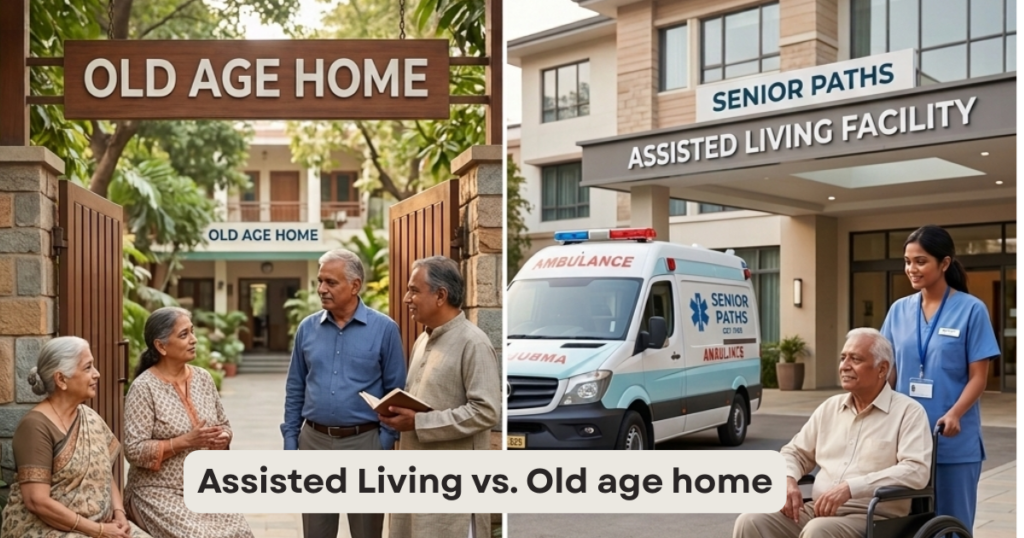
India’s senior living landscape is expanding rapidly. Based on industry estimates, there are approximately 6,000 old age homes and nearly 100+ functional assisted living facilities across the country.
The highest concentration of both is seen in major Tier 1 cities such as Bengaluru, Mumbai, Hyderabad, Chennai, and Kolkata, where rising nuclear families, NRI children, and urban ageing have increased demand for structured senior housing.
While old age homes are widely accessible across Tier 1, Tier 2, and even Tier 3 cities, assisted living facilities are heavily concentrated in Tier 1 and select Tier 2 cities. This uneven distribution plays a major role in decision-making, sometimes availability determines choice more than preference.
Although both are distinct senior residential options, assisted living facilities are often mistaken for a fancier or upgraded old age homes. The terms are often used interchangeably.
Assisted living vs Old age home: At a glance
| Feature | Assisted living | Old age home |
| Best suited for | Seniors needing daily support while staying active & independent | Seniors needing a safe, supervised living environment |
| Purpose | Structured support around the resident’s lifestyle | Accommodation with care and supervision |
| Medical care | In-house, structured care | Basic care, visiting medical staff |
| Staff to resident ratio | High, 1:1 options available | Lower, typically 1:6 or more |
| Nutrition | Planned & personalized meals | Standard meals, basic dietary options |
| Engagement | Structured programs & activities | Informal, self-directed |
| Cost | Affordable and premium options | Free, affordable and luxury options |
Note: Most old age homes(free and affordable options) follow the standard features outlined above. Premium old age homes, while fewer in number, can offer comparable comfort and amenities such as private rooms, quality meals, and organized activities.
Old Age Home is a residential facility created primarily to provide accommodation, meals, and community living for senior citizens.
Assisted Living is a residential care model created to provide structured assistance with Activities of Daily Living (ADLs) while preserving independence.
Old age homes have housing-first approach and assisted living facilities have care-first approach
What Is the Purpose of Assisted Living and Old Age Homes?
Old age homes in India emerged largely as a social welfare response, to support seniors who:
- Have no caregivers
- Face abandonment or neglect
- Cannot afford private care
- Need safe accommodation and food
Over time, this category has expanded and now exists at multiple tiers:
- NGO-run homes – Often free of cost
- Subsidized homes – Low monthly charges
- Private paid homes – Mid-range facilities
- Luxury old age homes – Premium infrastructure and lifestyle amenities
Assisted living evolved to fill a gap between independent living and hospital care.
It exists for seniors who:
- Cannot live completely independently
- Need daily assistance
- Are at fall risk
- Require structured monitoring
- Do not need hospital-level or ICU care
Its design begins with care assessment, structured support plans, and staffing models aligned to resident needs.
Are Assisted Living and Old Age Homes the Same Thing?
In India, there is no single central licensing category that strictly regulates the terminology.
The main difference between an assisted living facility and an old age home is structural and operational. Both serve a unique elder care need.
An old age home cannot accurately call itself assisted living unless it provides structured, assessed, ongoing ADL support as a core service.
An assisted living facility is not simply a premium old age home, it operates around documented care plans, higher staff-to-resident ratios, and defined care protocols.
Assisted Living vs Old Age Home: A Detailed Comparison
1. Infrastructure and Amenities
Old age homes typically have double or triple occupancy rooms with basic accessibility features such as wheelchair access and grab bars. Premium homes may offer private rooms and enhanced amenities.
Assisted living facilities typically offer single or double rooms or apartment-style units designed around mobility, safety, and ease of caregiving, with emergency systems integrated into the living space.
2. Staff and Services
Old age homes generally provide supervision and support staff. Staff to resident ratio is usually lower around 1:6 or more.
Assisted living facilities operate with trained caregiving and dedicated nursing staff focused on helping residents with ADLs, medication routines, and daily monitoring. Staff to resident ratio is usually higher about 1:3 with an option for 1:1 care.
3. Medical Care and Emergency Preparedness
Old age homes typically rely on visiting doctors, local hospital tie-ups, and basic nursing supervision. Premium old age homes have an in house medical team and ambulance for emergencies.
Assisted living facilities integrate care plans, medication management systems, routine monitoring, and defined emergency protocols as part of their operating model.
4. Food and Nutrition
Old age homes usually provide standardized meal plans with some dietary considerations. Luxury old age homes offer diet management and customizations.
Assisted living facilities structure meal planning around medical conditions and dietary needs.
5. Engagement and Daily Structure
Old age homes encourage community living, informal engagement and celebrations. This includes group activities, outings, volunteer visits, festival and birthday celebrations.
Assisted living facilities often implement structured daily routines aligned with health and cognitive needs. Additionally there are events, outings, group activities, indoor games and family events and celebrations.
6. Safety and Security
Both models typically maintain CCTV and security. Assisted living integrates safety into daily life with continuous monitoring, mobility assistance and escalation protocols. Old age homes in contrast focus on general supervision and basic support when required.
7. Cost and Affordability
Old age homes exist across income brackets:
- Free (NGO-run)
- Subsidized: ₹5,000-₹15,000/month
- Mid-range private: ₹15,000-₹50,000/month
- Premium private: ₹50,000 and above
Assisted living costs usually starts with ₹25,000/month and can go upto ₹1,20,000/month for premium facilities. For a detailed breakdown of what facilities charge across different cities, read our complete guide to the cost of assisted living in India.
Who Should Choose Assisted Living vs an Old Age Home?
Old Age Homes Are Best Suited For:
- Independent seniors who primarily need shelter and community
- Seniors with minimal daily assistance needs
Assisted Living Is Best Suited For:
- Seniors needing help with daily activities
- Those with early to moderate mobility or health challenges
- Individuals at fall risk
- Seniors who want independence with organized support
How to Choose Between Assisted Living and an Old Age Home
Is the primary need housing or daily care?
If you are an independent senior in a Tier 2 or Tier 3 city where assisted living options are limited, and primarily need safe accommodation, meals, and community living, an old age home may be suitable. This works best when there are minimal medical needs, no requirement for daily assistance, and affordability is in consideration.
If you or your loved one need help with daily activities such as bathing, mobility, or medication management, assisted living may be more suitable. It is particularly relevant if there are ongoing health conditions, fall risk or require safety monitoring but do not need hospital-level care. This option works well when maintaining independence, structured routines, emergency preparedness, and regular family involvement are important.